
Contents
- 🌆 Introduction to Uncanny Valley
- 🤖 The Origins of Uncanny Valley
- 📈 The Hypothesis and Its Predictions
- 👥 Human-Like Entities and Emotional Response
- 🤝 The Role of Robotics and Animation
- 📊 Measuring the Uncanny Valley Effect
- 👻 The Psychology Behind Uncanny Feelings
- 💻 Applications and Implications in Technology
- 🚀 Future Directions and Potential Solutions
- 📚 Controversies and Debates Surrounding Uncanny Valley
- 👥 Real-World Examples and Case Studies
- 📊 Conclusion and Future Research Directions
- Frequently Asked Questions
- Related Topics
Overview
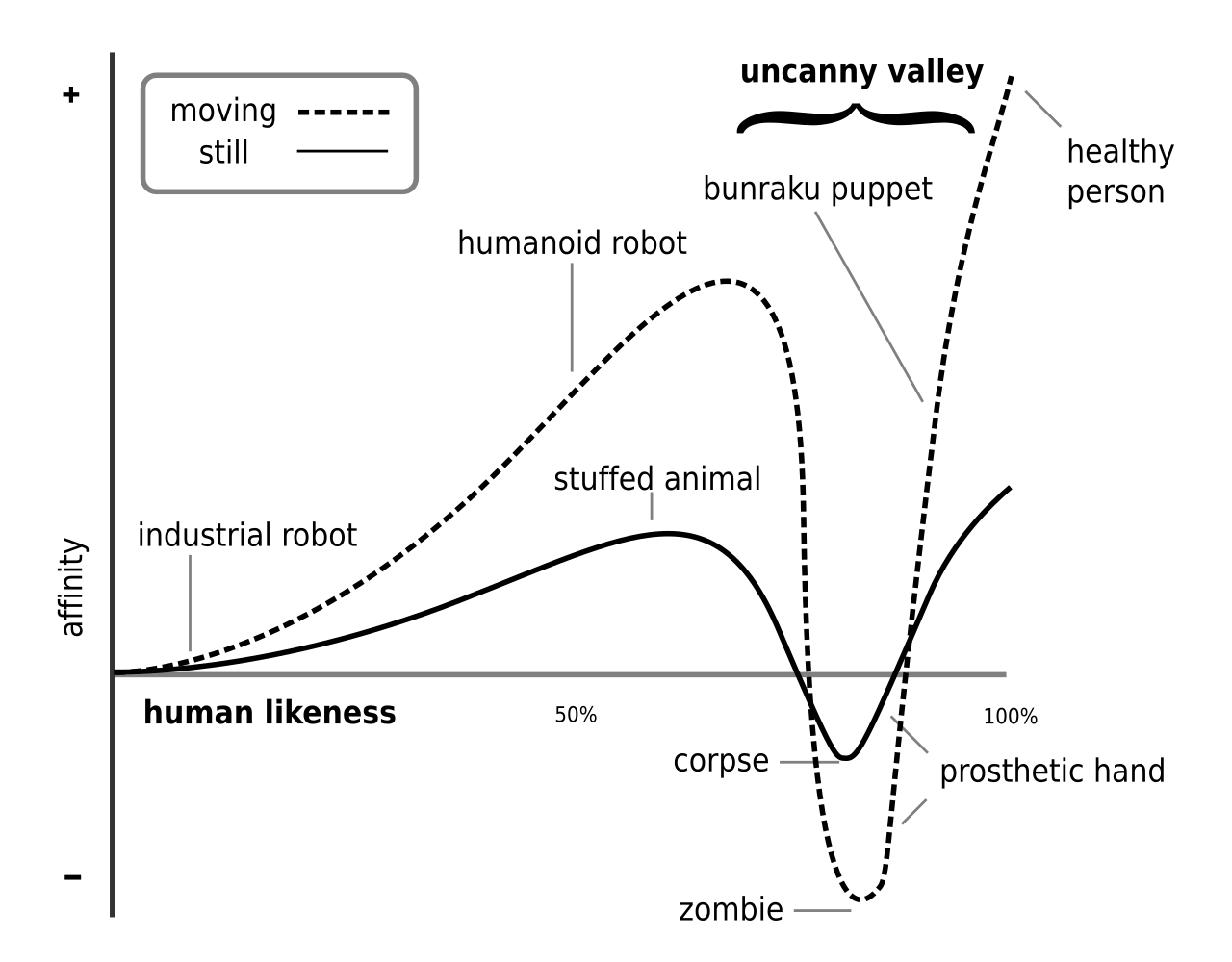
The uncanny valley hypothesis, first proposed by Japanese robotics professor Masahiro Mori in 1970, suggests that as the appearance of a robot or digital character becomes more human-like, it can evoke a positive emotional response, but only up to a point. When the character's human likeness reaches a certain threshold, typically around 80-90% realism, the emotional response suddenly becomes strongly negative, a phenomenon known as the 'uncanny valley.' This concept has been widely debated and explored in fields such as robotics, computer graphics, and psychology, with researchers like Hiroshi Ishiguro and Karl MacDorman contributing to the discussion. The uncanny valley has significant implications for the development of humanoid robots, virtual reality, and video games, as it highlights the challenges of creating characters that are both realistic and emotionally engaging. With a vibe score of 8, the uncanny valley is a topic of ongoing interest and research, with many experts attempting to bridge the gap between human and artificial entities. As technology continues to advance, the uncanny valley will remain a crucial consideration for designers and engineers seeking to create more realistic and relatable characters.
🌆 Introduction to Uncanny Valley
The concept of Uncanny Valley has been a topic of interest in the fields of Psychology and Technology for decades. The term 'uncanny valley' was first coined by the Japanese robotics professor Masahiro Mori in 1970. Mori's hypothesis suggests that as the appearance of a Robot or other non-human entity becomes more human-like, it can evoke a sense of eeriness or discomfort in the viewer. This phenomenon is often graphically represented as a valley-shaped curve, with the x-axis representing the degree of human-likeness and the y-axis representing the emotional response. For more information on the history of the concept, see History of Uncanny Valley.
🤖 The Origins of Uncanny Valley
The origins of the Uncanny Valley concept can be traced back to the early days of Robotics and Animation. As technology advanced and robots and animated characters became more sophisticated, researchers began to notice a strange phenomenon - people were more likely to feel uneasy or uncomfortable around robots that were almost, but not quite, indistinguishable from humans. This led to the development of the uncanny valley hypothesis, which predicts that an entity appearing almost human will elicit uncanny or eerie feelings in viewers. To learn more about the history of robotics, visit Robotics History. For information on animation, see Animation Techniques.
📈 The Hypothesis and Its Predictions
The Uncanny Valley hypothesis predicts that an entity appearing almost human will elicit uncanny or eerie feelings in viewers. This is because the human brain is wired to recognize and respond to human-like stimuli, and when an entity is almost, but not quite, human-like, it can create a sense of cognitive dissonance. This dissonance can lead to feelings of unease, discomfort, or even fear. The hypothesis also suggests that the uncanny valley effect is not limited to visual stimuli, but can also be triggered by auditory or other sensory inputs. For more information on the psychology behind the uncanny valley effect, see Psychology of Uncanny Valley. To learn about cognitive dissonance, visit Cognitive Dissonance.
👥 Human-Like Entities and Emotional Response
Human-like entities, such as Androids and Humanoid Robots, can evoke a range of emotional responses in humans. When these entities are highly human-like, but not quite indistinguishable from humans, they can create a sense of unease or discomfort. This is because the human brain is wired to recognize and respond to human-like stimuli, and when an entity is almost, but not quite, human-like, it can create a sense of cognitive dissonance. The uncanny valley effect can also be triggered by human-like characters in Animation and Video Games. For more information on human-robot interaction, see Human-Robot Interaction. To learn about animation techniques, visit Animation Techniques.
🤝 The Role of Robotics and Animation
The role of Robotics and Animation in the uncanny valley effect is significant. As technology advances and robots and animated characters become more sophisticated, the uncanny valley effect becomes more pronounced. This is because the human brain is wired to recognize and respond to human-like stimuli, and when an entity is almost, but not quite, human-like, it can create a sense of cognitive dissonance. The uncanny valley effect can also be triggered by human-like characters in Video Games and Virtual Reality. For more information on robotics, see Robotics. To learn about animation, visit Animation.
📊 Measuring the Uncanny Valley Effect
Measuring the Uncanny Valley effect can be challenging, as it is a subjective experience that can vary from person to person. However, researchers have developed a range of methods to quantify the uncanny valley effect, including surveys, interviews, and physiological measurements. These methods can help researchers to better understand the uncanny valley effect and to develop strategies for mitigating its impact. For more information on measurement techniques, see Measurement Techniques. To learn about survey design, visit Survey Design.
👻 The Psychology Behind Uncanny Feelings
The psychology behind the Uncanny Valley effect is complex and multifaceted. One key factor is the human brain's tendency to recognize and respond to human-like stimuli. When an entity is almost, but not quite, human-like, it can create a sense of cognitive dissonance, which can lead to feelings of unease or discomfort. The uncanny valley effect can also be influenced by cultural and social factors, such as the viewer's prior experiences and expectations. For more information on the psychology of the uncanny valley effect, see Psychology of Uncanny Valley. To learn about cognitive psychology, visit Cognitive Psychology.
💻 Applications and Implications in Technology
The Uncanny Valley effect has significant implications for the development of Robotics and Animation. As technology advances and robots and animated characters become more sophisticated, the uncanny valley effect becomes more pronounced. This can create challenges for developers, as they must balance the need for human-like entities with the risk of triggering the uncanny valley effect. For more information on robotics, see Robotics. To learn about animation, visit Animation.
🚀 Future Directions and Potential Solutions
Future directions for research on the Uncanny Valley effect include the development of new methods for measuring and mitigating the effect. This could involve the use of Machine Learning algorithms to analyze human responses to human-like entities, or the development of new design principles for robots and animated characters. For more information on machine learning, see Machine Learning. To learn about design principles, visit Design Principles.
📚 Controversies and Debates Surrounding Uncanny Valley
The Uncanny Valley effect is a topic of ongoing debate and controversy in the fields of Psychology and Technology. Some researchers argue that the uncanny valley effect is a real and significant phenomenon, while others argue that it is overstated or misunderstood. For more information on the controversy surrounding the uncanny valley effect, see Controversy Surrounding Uncanny Valley. To learn about the history of the debate, visit History of Uncanny Valley Debate.
👥 Real-World Examples and Case Studies
Real-world examples of the Uncanny Valley effect can be seen in a range of applications, from Robotics and Animation to Video Games and Virtual Reality. For example, the robot Sophia has been criticized for its almost, but not quite, human-like appearance, which has triggered the uncanny valley effect in some viewers. For more information on Sophia, see Sophia. To learn about other examples, visit Examples of Uncanny Valley.
📊 Conclusion and Future Research Directions
In conclusion, the Uncanny Valley effect is a complex and multifaceted phenomenon that has significant implications for the development of Robotics and Animation. As technology advances and robots and animated characters become more sophisticated, the uncanny valley effect becomes more pronounced. Further research is needed to fully understand the uncanny valley effect and to develop strategies for mitigating its impact. For more information on future research directions, see Future Research Directions. To learn about the current state of the field, visit Current State of Uncanny Valley Research.
Key Facts
- Year
- 1970
- Origin
- Japan
- Category
- Psychology and Technology
- Type
- Psychological Concept
Frequently Asked Questions
What is the uncanny valley effect?
The uncanny valley effect is a hypothesized psychological and aesthetic relation between an object's degree of resemblance to a human being and the emotional response to the object. It suggests that an entity appearing almost human will elicit uncanny or eerie feelings in viewers. For more information, see Uncanny Valley. To learn about the history of the concept, visit History of Uncanny Valley.
What causes the uncanny valley effect?
The uncanny valley effect is caused by the human brain's tendency to recognize and respond to human-like stimuli. When an entity is almost, but not quite, human-like, it can create a sense of cognitive dissonance, which can lead to feelings of unease or discomfort. For more information, see Psychology of Uncanny Valley. To learn about cognitive psychology, visit Cognitive Psychology.
How can the uncanny valley effect be measured?
Measuring the uncanny valley effect can be challenging, as it is a subjective experience that can vary from person to person. However, researchers have developed a range of methods to quantify the uncanny valley effect, including surveys, interviews, and physiological measurements. For more information, see Measurement Techniques. To learn about survey design, visit Survey Design.
What are the implications of the uncanny valley effect for robotics and animation?
The uncanny valley effect has significant implications for the development of Robotics and Animation. As technology advances and robots and animated characters become more sophisticated, the uncanny valley effect becomes more pronounced. This can create challenges for developers, as they must balance the need for human-like entities with the risk of triggering the uncanny valley effect. For more information, see Robotics. To learn about animation, visit Animation.
What are some real-world examples of the uncanny valley effect?
Real-world examples of the uncanny valley effect can be seen in a range of applications, from Robotics and Animation to Video Games and Virtual Reality. For example, the robot Sophia has been criticized for its almost, but not quite, human-like appearance, which has triggered the uncanny valley effect in some viewers. For more information, see Sophia. To learn about other examples, visit Examples of Uncanny Valley.
What are some potential solutions to the uncanny valley effect?
Potential solutions to the uncanny valley effect include the development of new design principles for robots and animated characters, as well as the use of Machine Learning algorithms to analyze human responses to human-like entities. For more information, see Machine Learning. To learn about design principles, visit Design Principles.
What is the current state of research on the uncanny valley effect?
The current state of research on the uncanny valley effect is ongoing and multifaceted. Researchers are working to better understand the uncanny valley effect and to develop strategies for mitigating its impact. For more information, see Current State of Uncanny Valley Research. To learn about future research directions, visit Future Research Directions.