
Contents
- 🌌 Introduction to Optical Astronomy
- 🔍 History of Optical Astronomy
- 🔎 Telescopes in Optical Astronomy
- 🌈 Electromagnetic Radiation Spectrum
- 📊 Visible Light and Its Wavelength
- 👩🔬 Astronomers and Their Contributions
- 🚀 Space Exploration and Optical Astronomy
- 🤔 Challenges in Optical Astronomy
- 📸 Imaging and Data Analysis
- 🌐 Future of Optical Astronomy
- 📚 Resources and References
- Frequently Asked Questions
- Related Topics
Overview
Optical astronomy, with a vibe score of 8, has been a cornerstone of human curiosity, driving our understanding of the universe from ancient civilizations to modern space telescopes. The historian's lens reveals that early astronomers like Galileo Galilei and Johannes Kepler laid the groundwork for later discoveries. However, the skeptic's perspective questions the limitations of optical astronomy, such as interference from the atmosphere and the constraints of visible light. The fan's enthusiasm is palpable when considering iconic observatories like the Mauna Kea Observatory, which have significantly advanced our knowledge. The engineer's inquiry into how optical telescopes work highlights the intricate dance of mirrors, lenses, and detectors. As the futurist looks ahead, the next generation of telescopes, like the Giant Magellan Telescope, promises to unveil unprecedented details of the cosmos, with a projected completion date of 2029 and a budget of over $1 billion, sparking debates about the allocation of resources in the scientific community, with some arguing that the funds could be better spent on more pressing issues, while others see it as a crucial investment in humanity's quest for knowledge. The influence of optical astronomy can be seen in the work of scientists like Dr. Neil deGrasse Tyson, who has been instrumental in promoting the field and its discoveries to a broader audience.
🌌 Introduction to Optical Astronomy
Optical astronomy, also known as visible-light astronomy, is a branch of astronomy that deals with the study of celestial objects and phenomena using telescopes that are sensitive to visible light. This type of astronomy is distinct from other forms of astronomy, such as Radio Astronomy and Infrared Astronomy, which use different wavelengths of the electromagnetic radiation spectrum. The visible light range, spanning from 380 to 750 nanometers in wavelength, is the primary focus of optical astronomy. Astronomers use Telescopes to observe and study celestial objects, such as stars, planets, and galaxies, to gain a deeper understanding of the universe. For more information on the history of astronomy, visit Astronomy.
🔍 History of Optical Astronomy
The history of optical astronomy dates back to ancient civilizations, with early astronomers using simple telescopes to observe the night sky. The invention of the Refracting Telescope by Galileo Galilei in the 17th century marked a significant milestone in the development of optical astronomy. Since then, telescopes have become increasingly sophisticated, with the use of Reflecting Telescopes and other technologies. The study of optical astronomy has led to numerous discoveries, including the observation of Supernovae and the detection of Exoplanets. To learn more about the history of telescopes, visit Telescope History.
🔎 Telescopes in Optical Astronomy
Telescopes play a crucial role in optical astronomy, allowing astronomers to observe and study celestial objects in greater detail. There are several types of telescopes used in optical astronomy, including Refracting Telescopes and Reflecting Telescopes. The choice of telescope depends on the specific application and the desired level of detail. Astronomers also use various techniques, such as Spectroscopy and Interferometry, to analyze the light emitted by celestial objects. For more information on telescope types, visit Telescope Types.
🌈 Electromagnetic Radiation Spectrum
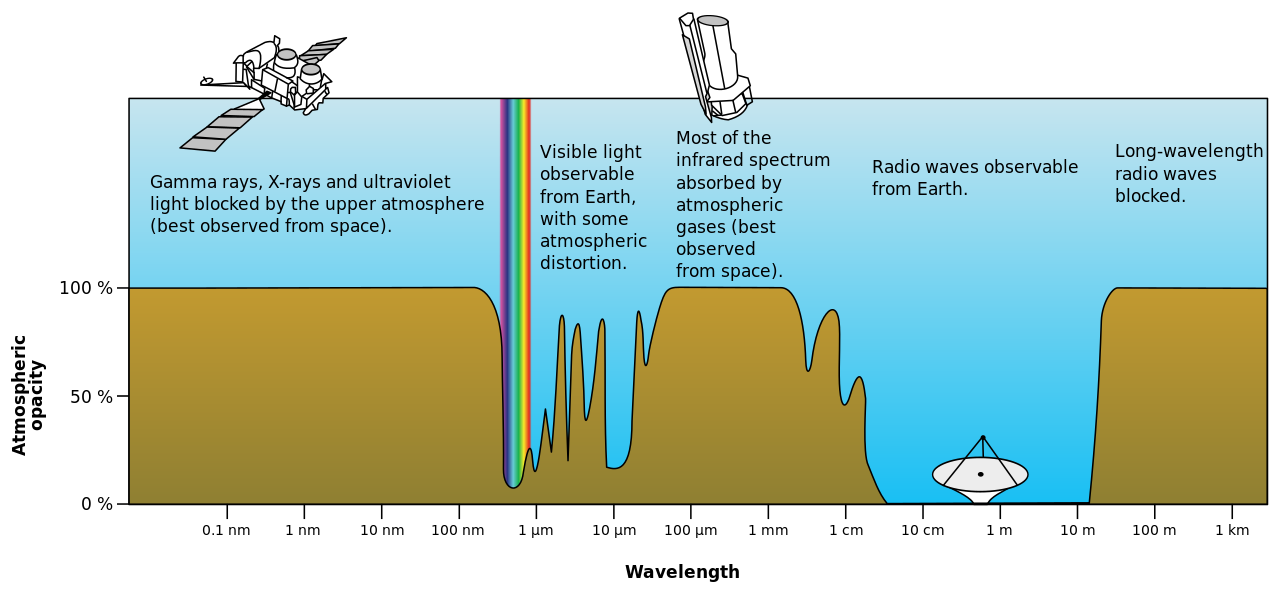
The electromagnetic radiation spectrum is a broad range of wavelengths, including radio waves, infrared waves, ultraviolet waves, X-ray waves, and gamma-ray waves. Optical astronomy focuses on the visible light range, which spans from 380 to 750 nanometers in wavelength. This range is relatively narrow compared to other forms of electromagnetic radiation, but it provides a wealth of information about celestial objects. Astronomers use Spectrographs to analyze the light emitted by celestial objects and gain insights into their composition and properties. To learn more about the electromagnetic radiation spectrum, visit Electromagnetic Radiation.
📊 Visible Light and Its Wavelength
Visible light is a form of electromagnetic radiation that is visible to the human eye. It has a wavelength range of 380 to 750 nanometers, which is relatively narrow compared to other forms of electromagnetic radiation. The study of visible light is essential in optical astronomy, as it provides information about the temperature, composition, and motion of celestial objects. Astronomers use Photometry to measure the brightness of celestial objects and gain insights into their properties. For more information on visible light, visit Visible Light.
👩🔬 Astronomers and Their Contributions
Astronomers have made significant contributions to the field of optical astronomy, from the early observations of Galileo Galilei to the modern-day discoveries of Neil deGrasse Tyson. The work of astronomers such as Isaac Newton and Albert Einstein has also had a profound impact on our understanding of the universe. Today, astronomers continue to push the boundaries of optical astronomy, using advanced technologies and techniques to study celestial objects in greater detail. To learn more about famous astronomers, visit Famous Astronomers.
🚀 Space Exploration and Optical Astronomy
Space exploration has revolutionized the field of optical astronomy, providing astronomers with new opportunities to study celestial objects in greater detail. The use of Space Telescopes, such as the Hubble Space Telescope, has enabled astronomers to observe celestial objects that are too distant or too faint to be detected by ground-based telescopes. Space exploration has also led to the discovery of new celestial objects, such as Exoplanets and Brown Dwarfs. For more information on space exploration, visit Space Exploration.
🤔 Challenges in Optical Astronomy
Despite the many advances in optical astronomy, there are still several challenges that astronomers face. One of the main challenges is the Atmospheric Interference that occurs when light passes through the Earth's atmosphere. This interference can distort the image of celestial objects, making it difficult to obtain accurate measurements. Astronomers use various techniques, such as Adaptive Optics, to overcome this challenge. To learn more about atmospheric interference, visit Atmospheric Interference.
📸 Imaging and Data Analysis
Imaging and data analysis are critical components of optical astronomy, as they enable astronomers to extract valuable information from the data collected by telescopes. Astronomers use various techniques, such as Image Processing and Data Mining, to analyze the data and gain insights into the properties of celestial objects. The use of Machine Learning algorithms has also become increasingly popular in optical astronomy, as it enables astronomers to automate the analysis process and identify patterns in the data. For more information on imaging and data analysis, visit Imaging and Data Analysis.
🌐 Future of Optical Astronomy
The future of optical astronomy is exciting, with several new technologies and missions on the horizon. The use of Next-Generation Telescopes, such as the James Webb Space Telescope, will enable astronomers to study celestial objects in greater detail than ever before. The development of new technologies, such as Quantum Entanglement, will also provide new opportunities for optical astronomy. To learn more about the future of optical astronomy, visit Future of Optical Astronomy.
📚 Resources and References
For those interested in learning more about optical astronomy, there are several resources available. The Astronomical Society provides a wealth of information on optical astronomy, including articles, videos, and podcasts. The National Aeronautics and Space Administration (NASA) also provides a range of resources, including images, videos, and news articles. For more information on resources and references, visit Resources and References.
Key Facts
- Year
- 1609
- Origin
- Italy, with Galileo Galilei's first telescope observations
- Category
- Astronomy
- Type
- Scientific Discipline
Frequently Asked Questions
What is optical astronomy?
Optical astronomy is a branch of astronomy that deals with the study of celestial objects and phenomena using telescopes that are sensitive to visible light. It is distinct from other forms of astronomy, such as radio astronomy and infrared astronomy, which use different wavelengths of the electromagnetic radiation spectrum. For more information on optical astronomy, visit Optical Astronomy.
What is the electromagnetic radiation spectrum?
The electromagnetic radiation spectrum is a broad range of wavelengths, including radio waves, infrared waves, ultraviolet waves, X-ray waves, and gamma-ray waves. Optical astronomy focuses on the visible light range, which spans from 380 to 750 nanometers in wavelength. To learn more about the electromagnetic radiation spectrum, visit Electromagnetic Radiation.
What are the challenges in optical astronomy?
Despite the many advances in optical astronomy, there are still several challenges that astronomers face. One of the main challenges is the atmospheric interference that occurs when light passes through the Earth's atmosphere. This interference can distort the image of celestial objects, making it difficult to obtain accurate measurements. Astronomers use various techniques, such as adaptive optics, to overcome this challenge. For more information on challenges in optical astronomy, visit Challenges in Optical Astronomy.
What is the future of optical astronomy?
The future of optical astronomy is exciting, with several new technologies and missions on the horizon. The use of next-generation telescopes, such as the James Webb Space Telescope, will enable astronomers to study celestial objects in greater detail than ever before. The development of new technologies, such as quantum entanglement, will also provide new opportunities for optical astronomy. To learn more about the future of optical astronomy, visit Future of Optical Astronomy.
What are some resources for learning more about optical astronomy?
For those interested in learning more about optical astronomy, there are several resources available. The Astronomical Society provides a wealth of information on optical astronomy, including articles, videos, and podcasts. The National Aeronautics and Space Administration (NASA) also provides a range of resources, including images, videos, and news articles. For more information on resources and references, visit Resources and References.
Who are some famous astronomers?
Astronomers have made significant contributions to the field of optical astronomy, from the early observations of Galileo Galilei to the modern-day discoveries of Neil deGrasse Tyson. The work of astronomers such as Isaac Newton and Albert Einstein has also had a profound impact on our understanding of the universe. To learn more about famous astronomers, visit Famous Astronomers.
What is the role of telescopes in optical astronomy?
Telescopes play a crucial role in optical astronomy, allowing astronomers to observe and study celestial objects in greater detail. There are several types of telescopes used in optical astronomy, including refracting telescopes and reflecting telescopes. The choice of telescope depends on the specific application and the desired level of detail. For more information on telescopes, visit Telescopes.